Welcome to my Human Interest Stories website!
I worked at Plan International-Pakistan (an iNGO) as Communications Manager from 2011 to 2012. During this period, I produced more than 80 human interest stories by visiting field sites in Badin, Thatta, Rajan Pur, Layyah, Muzzafar Garh, and Bari Imam.
Below, you can read 12 of my selected case studies.
1. Maryam: Early marriage has ruined Praveen's life

Maryam is in New York with Plan to talk about rural life as a girl in Pakistan
February 2012: Maryam, 15, from Pakistan, is one of the 9 girl delegates from rural communities across the world that Plan is supporting at the UN's 56th Commission on the Status of Women (CSW).
Here's the story she shared at a side event in New York on early and forced marriage in her community.
"I
know of a girl a called Praveen who is 12 years old. She lives in a nearby
village.
Praveen’s
parents arranged for her to marry a man who is 32 years old. The girl was sent
to live with the man’s family as his wife, even though she did not know the
meaning of the word ‘marriage’.
Praveen
was too young, with a childish mind and thinking. She liked to play with toys
in her husband’s house. These were the toys belonging to the grandchildren of
her parents-in-law.
Praveen’s
mother-in-law was not very good to her. She got angry when Praveen played and
complained to Praveen’s father that she often eats the tomatoes she is meant to
be cooking for the family.
Divorced and ruined aged 12
After 3
months of marriage, Praveen’s husband decided to divorce. He was angry with
her. She was too innocent and unable to adapt to her husband and his family.
Even though she was 12 years old, Praveen’s parents blamed her for the divorce.
In the community it is the girls’ fault if she divorces, not the man’s.
After
the divorce, Praveen was sent back to live with her parents where she weeps and
remains sad. At the age of 12, she does not know the meaning of marriage and
divorce has ruined her life. Now her parents feel she is a burden and want to
marry her away again as soon as possible.
I will work to protect girls
I think
that early marriage stops the mental, physical and educational growth of the
girls and they are not able to participate in the development and progress of
their family life as well as country and community.
I will
work in my community to help reduce the rate of girls who are affected by early
and forced marriages. I will give them awareness, conduct meetings with them,
share experience with them and discuss with them in simple language.
Parents,
families and girls may think marriage sounds charming, because they can get new
clothes, but they should keep in mind the hard realities of what early and
forced marriage brings. The dream will be broken."
-------------------------------------------------------------------------------------------------------------------------------------------------------------------------------------------------------------------
2. Small business - A big help for family
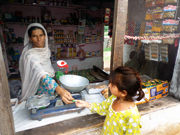
Nadia now has high hopes for the future.
June 2012: Nadia has 8 children with her husband, Mansur, and together they live in a 1-room house in Islamabad. Until recently, none of the children went to school because the family couldn't afford to send them. But life has taken a turn for the better as the family now have a business to call their own.
Data
collected by Plan found that Nadia and her family were living below the poverty
line, so Plan selected them to take part in an income-enhancement project.
Mansur went to business management training and he was able to pass on what he
learnt to his wife. A small start-up grant was then provided to the family for
them set up a small food shop.
“It was
a turning point for our family. You can see the change in our children’s lives.
My elder son joined a fast-track secondary education centre to complete his
schooling. Soon he will take the education board examination to get his upper
secondary certificate. He is also working as a sweeper in the evening,” said
Nadia.
“My 2
daughters are starting their schooling at a primary, non-formal education
centre and I hope that they will soon be able to join a formal school. My 2
younger sons attend an Early Childhood Care and Education centre and will be
enrolled in formal school next year,” she added.
Learning the tricks of the trade
Mansur
has learnt about the importance of consistency and planning. In the past, he
moved from job to job, never giving himself time to really get settled into
anything. Through his newfound business sense, Mansur has also come to
understand the importance of education for his family.
“If
wives and daughters are educated and skilled it means more earning hands. I
encouraged and trained my wife to run the business together with me. I am also
trying to provide vocational training to my elder daughter. Together we can
change our situation, ” he said.
Looking forward
Nadia
and Mansur now earn 3-4,000 rupees (US$30-40) a month. Mansur keeps track
of the money and keeps a record of the daily income, while members of the
village committee keep an eye on how things are going, all with support from
Plan and local partners.
With a
steady income, Nadia and Mansur now plan to expand their shop with the help of
a small loan from Plan partner Bari Imam House. Not only that, but they
are also helping their neighbours set up their own businesses.
-------------------------------------------------------------------------------------------------------------------------------------------------------------------------------------------------------------------
3. Lack of birth registrations keeps children out of school
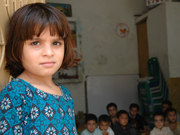
Sania says she loves going to school and learning with her friends.
May 2012: Sania, 7, is a very shy girl who lives in the slums of Islambad in Pakistan. She loves books and learning and was keen to go to school after graduating from a preschool supported by Plan Pakistan’s early childhood care and development (ECCD) initiative.
As her former caregiver Rehana observed, “She loves studying and questioning. She is now 7 years old and it is time for her to go to primary school.”
But Sania faced a challenge, bigger even than overcoming the initial resistance of her father, who had thought education was wasted on a girl: Sania had no birth certificate. Without one, it’s difficult to enroll in any primary school.
Low birth registration
Sania was one of many
Pakistani children who have been denied the right to be registered after birth,
a right that leads to benefits like education and protects against child labour
and child marriage.
In some districts of Pakistan, fewer than 1 in 10 births are registered – and it’s especially tough for girls. In Kyber Pakhtunkhwa province, for example, from January 2005 to February 2008, 5.7% of boys had their births registered compared to just 3.6% of girls. With statistics appearing to show fewer girls than actually exist, funding for girls’ education has been seriously shortchanged.
On the books
In 2000, Plan
initiated a package of programmes targeting children, communities, schools,
media, and local and national authorities to sort out Pakistan’s birth
registration troubles.
With support from the local government and the National Database and Registration Authority, Plan piloted its efforts in 4 districts of Khyber Pakhunkwha before scaling up to cover the entire province, as well as 4 districts of Baluchistan province and 2 of Sindh. As a result, more than 1,600,000 children have had their births registered.
But some children still fall through the cracks. There are pockets, including the slum where Sania lives, where the campaign struggles to reach. “Most parents don’t bother registering their children, especially girls, at birth. Some parents cannot envision its advantages,” said Sania’s father.
All of Sania's uncertainty and heartache could have been avoided had she been registered at birth. But luckily, this story has a happy ending: Though not the ideal solution, an alternative document to register her was used and with a little help from Plan Sania eventually got a place in a primary school -- where she belongs.
“I like playing and studying with my new friends very much,” she said.
------------------------------------------------------------------------------------------------------------------------------------------------------------------------------------------------------------------
4. Friendly centres give young people inside scoop on health issues
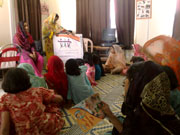
Young people can learn about important issues in a friendly, relaxed atmosphere.
May 2012: Madiha, 18, was a caregiver at the early childhood centre that Plan had set up in her village, Takia Shah Murad, in Pakistan. As well as working at the centre, she was enrolled in a private college near her village where she would attend classes in the evenings.
The early childhood centre she ran was set up on the premises of
a large compound, adjacent to her home. One day, Madiha’s friend persuaded her
to join Plan Pakistan’s reproductive health initiative with adolescents project and
become a member of the Adolescent Friendly Centre. By doing this, she could get
useful information and training opportunities on health issues.
“At
first, I did not know exactly what goes on at the Adolescent Friendly Centre. I
decided to be part of it because of my friend. Also the place was next to my
kids’ school. I was interested in young children’s health issues and diseases,”
Madiha said.
Valuable lessons
A couple
of weeks later, a special session was organised at the centre where a Plan
community development facilitator and a doctor from Plan delivered lectures.
They spoke about a fast-spreading disease called hepatitis and the measures
necessary to prevent the disease.
Learning
that hepatitis was caused by uncleanliness alarmed Madiha, as nobody in her
family particularly cared about keeping the house clean. Upon returning home,
she shared this information with her parents and sisters. She found that her
mother was experiencing some symptoms of hepatitis.
A trip to the doctor
The next
day, Madiha and her mother went to the nearby town of Khanpur to be tested for
hepatitis. The test results showed that Madiha’s mother was hepatitis-A
positive. The doctor reassured them that it was curable and prescribed some
medicine. He also advised them to ensure that their house was kept clean.
After
that, Madiha’s family made sure the house was kept clean, that they washed
their hands regularly and treated bruises and cuts instantly. Madiha was
thankful for her decision to join the Adolescent Friendly Centre as it gave her
lifesaving information for her family.
--------------------------------------------------------------------------------------------------------------------------------------------------------------------------------------------------------------------
5. Being a teenager in Pakistan
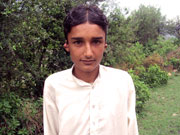
Nadeem soon learnt that he wasn't so different from everybody else.
June 2012: Nadeem, 16, lives in a large village deep in the rugged hills of Salt
Range, Pakistan. He was in grade 9 when he started experiencing something that
most boys and girls face entering adolescence: pimples. Both his cheeks were
covered with red bumps and he felt embarrassed by his appearance. He became shy
around his friends and cousins and started avoiding people as they were giving
him odd looks and making remarks.
There
were no proper medical facilities in Nadeem’s village. As in most rural areas,
people experiment with home remedies or consult local doctors when they have
health issues.
Traditional rememdies
Once,
Nadeem visited the homeo-physician in a nearby town. The physician examined
Nadeem and said that his stomach and liver were producing extra heat, resulting
in the transfusion of heat in his blood and creating pimples. The physician
warned that he may have a serious disease.
The
homeopath gave him a one-month course of herbal ointments, syrups and tablets.
When Nadeem came out of the clinic, he felt more dejected than before. “Before
visiting the doctor I was just worried about the scars on my face, but the
hakeem (physician) told me that I have severe health problems that might lead
to consequences in future,” he said.
Nadeem
took the medicines regularly but to no avail. One day, he met a young boy who
attended the village’s Adolescent Friendly Centre (AFC). The centre was
actually a health facility for the village boys and girls and had been set up
by Plan under the reproductive health initiatives with adolescents programme
(RHIA), a project focused on adolescent empowerment. This project aims to
ensure adolescents receive factual, clear, comprehensive and age-appropriate
information about their sexuality and reproductive health and to equip them
with related life skills to deal with it.
Healthy advice
Nadeem
met the staff at the centre and soon started attending health sessions in the
evenings. Within a week or two he learnt that his pimples were not a serious
problem, but rather a normal part of growing up. Nadeem was no longer worried
and now knew that they would gradually disappear.
Nadeem’s
confidence returned and his shyness faded. He became a regular member of the
adolescent centre, eagerly participating in the activities offered by visiting
Plan staff and youths associated with the community.
--------------------------------------------------------------------------------------------------------------------------------------------------------------------------------------------------------------------
6. On the road for a quick cash boost
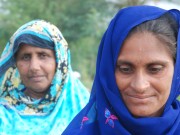
Basheer (right) was left with an uncertain future few months ahead
April
2012: When flood waters ravaged parts of Pakistan last year, farmers and land
labourers could only watch in horror as crops were ruined and homes washed
away. With no way to make a living off the land, many villagers had to look for
other ways just to make ends meet.
Basheer
Mai from Mol Wala in Teshsil Kot Addu, Muzaffargarh district, is illiterate and
landless, living in a mud hut with her 8 children and sick husband. The
flooding was a huge setback for Basheer as the land she used to work on to make
a wage was now under water. Having lost the only way she knew how to support
her family, the future looked bleak.
“The
floods caused heavy damage to agriculture in the area. I could not feed my
children properly as there was no work. I had lost all hope to earn bread for
my family. I was worried and desperate to feed them. How could I even think of
my husband's medical treatment when my children were starving?” she said.
The road to recovery
Basheer’s
life took a turn for the better when she got involved in a Cash for Work
programme implemented by Plan Pakistan and the Doaba Foundation. Basheer and 99
other villagers worked together on the month-long repairing the village access
road. From the money earned she was able to buy enough food to feed her family
for the foreseeable future with a little left over to go towards school fees
and medical bills.
“This
project gave me some much-needed financial support. More importantly, it gave
me a dignified way to support my family by providing an opportunity for me to
earn money,” she added.
Tricky times
Sakena
Mai, a widow and mother of 3, including a 20-year-old son with tuberculosis,
found herself in a similar position in Basti Ghali Chanderer, Lohanch Nashib
Union Council.
“The
flood in Basti Ghali Chanderer affected us very badly and 90% of the crops and
houses were destroyed,” she said.
Just
like in Mol Wala, Plan and Doaba rolled out a Cash for Work project to repair
the village access road, giving distraught villagers a way to earn a living and
make up for some of their losses at the hands of the flood.
“With
the money earned I am able to afford medical treatment of my son and I can buy
other important things for my home,” she added.
-------------------------------------------------------------------------------------------------------------------------------------------------------------------------------------------------------------------
7. Clean water at last!
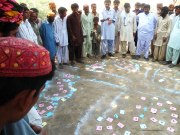
These villagers saw the problem and came up with the solution.
January
2012: The people of Goth Mohammad Bakhsh in Dera Allah Yar district,
Baluchistan province, knew that the water they drank had been contaminated by
seepage from a septic tank -- they could see human excrement floating on the
pond they gathered it from -- but they also knew that without that water,
they’d go thirsty.
As
villager Haji Abdul Aziz Khosa explained, “There was no proper source of water
safe to drink or to use for domestic purposes.” In fact, the 350 households of
the village were drawing water from the same pond their livestock bathed
in.
The villagers’ lives have now been transformed by an initiative
jointly supported by Plan Pakistan and
its local partner, Islamic Relief, which saw a team of social mobilisers travel
across the flood-affected districts of Naseerabad and Jaffarabad to educate
200,000 people on the joys of hand-washing, sanitation, drainage systems, the
consumption of safe drinking water and the safe disposal of human waste.
Keeping it in the community
In Goth
Mohammad Bakhsh, a social mobiliser helped the community conduct what’s called “social
mapping”, for which villagers identify and prioritise their key developmental
problems at a public meeting.
Providing
clean water was at the top of the list. Together, villagers traced the source
of contamination of the pond and discussed the possible repercussions. Then,
they decided to clean out the old septic tank. The 2,450 residents have since
seen a decrease in the number of people getting sick from water-borne diseases.
Haji
Aziz added that villagers also learned about the importance of personal
hygiene, which had never been discussed before.
“No
doubt these steps are for our own benefit. We were not following them before
due to a lack of awareness. We are satisfied with the efforts of programme implementation and we hope to be helped out in future.”
Meanwhile,
the social mobilisers have moved on to other areas in need of support,
spreading their message of cleanliness and ensuring villagers live happier,
healthier lives.
-------------------------------------------------------------------------------------------------------------------------------------------------------------------------------------------------------------------
8. Ending open defecation in rural Pakistan
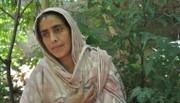
Shazma led the way in her community
January
2012: More than 1/3 of Pakistanis living in rural areas don’t have toilets.
People young and old, healthy and infirm, male and female are forced to use the
great outdoors as their loo, making use of bushes, riverbanks, open fields and
small groves.
Not only
are open-defecation sites smelly and unsightly, but the resultant contamination
of water supplies causes disease as villagers blithely use untreated water,
assuming that clean to the eye means clean in an absolute sense.
Fortunately, with the help of a local partner, Integrated Rural
Support Programme (IRSP), Plan Pakistan is
changing this dire state of affairs. In 13 villages in Sawaldher Union Council,
Khyber Pakhtunkhwa province, more than 450 community resource persons (CRPs)
are motivating villagers at health and hygiene sessions to encourage people to
build toilets and stop the spread of disease. So far, so good.
A murky start
Consider
the “before” state in a typical village like Balandi, where 40-year-old Shazma
lives with her 9 children. Shazma’s family suffered terribly from not having a
toilet: skin disease as well as diarrhea and other gastro-intestinal disorders
plagued them.
In fact,
Shazma's daughter, Nazia, developed a nasty infection on her leg that oozed pus
for days -- all because the family didn’t know about the importance of good
hygiene.
But now,
after attending a mixed-gender health-and-hygiene session that delivered the
disturbing message that the family had in effect been consuming their own
excreta, Shazma was finally convinced she needed a toilet -- immediately.
A bright future
With an
initial outlay of just 2,100 rupees ($40), Shazma’s family built a temporary
toilet. Now, after investing another 4,000 rupees ($77) to buy the materials
she needs to build a permanent structure, Shazma is just waiting on a skilled
mason to construct it.
With the
demand in Balandi so high -- the village set a goal of total sanitation, with
100% of households committed to build toilets -- everyone has to wait his or
her turn.
The
training of masons, like the “trigger sessions”, will also be conducted by
IRSP, but only after the current design is suitably modified. A demonstration
toilet currently serves as a reminder of the good things to come.
In the
meantime, Shazma and her family are enjoying their good health, the fragrant
air and the clean surroundings. Those late-night dashes to the fields, fearful
of snake bites or worse, are now a distant memory.
--------------------------------------------------------------------------------------------------------------------------------------------------------------------------------------------------------------------
9. Children take the lead in cleaning up

Samiullah now knows all the right moves to keep his hands clean
January
2012: Sometimes mastering the simplest of tasks can make a world of difference.
6-year-old Samiullah from Sawaldher Mardan Union Council, Khyber Pakhtunkhwa
province, is an expert in handwashing and has been teaching friends, family and
neighbours about the positive impacts of good hygiene.
He knows
all 6 steps like the back of this hand:
2. lather them with soap
3. scrub the palms and backs
4. wash each finger separately
5. rinse your hands thoroughly
6. dry your hands
Like father like son
His father, Subhanullah, is a practicing homeopathic physician who, along with 450 others, was trained as a community resource person by Plan Pakistan's local partner, Integrated Rural Support Programme, as part of a handwashing campaign that has drastically cut incidences of the water-borne diseases that once plagued 12 target villages in Sawaldher. While Subhanullah uses his medical expertise to help with raising awareness of the virtues of good personal hygiene, his son relies on his youthful energy.
“Let me tell you all how to wash your hands properly as by washing our hands properly we can make sure all the germs go down the drain,” says Samiullah.
“You need to understand when to wash your hands: after using the toilet, after playing, and before and after eating.”
With such confidence and conviction, Samiullah has persuaded dozens of his peers to change their old ways. The 16,000 inhabitants of the area are being brought the message that handwashing with soap is essential for good health.
Healthy, happy, heroes
With the children of Samiullah’s and other villages well schooled in the fine art of proper handwashing, they no longer suffer from recurrent diarrhoea, vomiting and other ailments – plus they are keen to share the good news with others.
Among them is 9-year-old Zakia, who says she hardly ever used to wash her hands and didn't even know the simple steps. Now, thanks to a health and hygiene training Subhanullah conducted in her village, she is another young expert who can teach others.
Across Sawaldher Mardan Union Council, more and more brightly-coloured soap dishes and well-used bars of soap decorate household and community tap stands, reminding all of an easy method to stay healthy.
But the transformation hasn't stopped at personal hygiene: those who learn about the need to wash their hands also learn that that they need to build toilets to avoid faecal contamination and so the demand for toilets in the area has skyrocketed -- slowly but surely, open defecation, the scourge of rural Pakistan, is also being eliminated.
--------------------------------------------------------------------------------------------------------------------------------------------------------------------------------------------------------------------
10. Clean water helps prevent illness in
flood-hit Pakistan

Some 80,000 people in Badin now receive 200,000 litres of safe, drinking water every day
November
2011: Jaan Mohamma, 11, had to walk many kilometres from his home to fetch
water from wells after floods in August and September contaminated the water
supply in his village in Badin, a district in southern Pakistan’s
disaster-prone Sindh province.
“It was
too salty for me to drink. For some people who drank it, they caught diarrhea,” says Jaan as he fills up his jerry can with clean, drinkable water
from a blue tank provided by Plan Pakistan and local partner HANDS.
“Now I
am happy that the water source is so close to home,” says Jaan, who now doesn’t
have to sacrifice his school time for water fetching.
Deep impact
Heavy
rains and floods in late August and early-September have killed some 200 people
and made 6.8 million homeless or displaced across Pakistan. Out of those
affected people, 1.8 million of them live in Badin, the worst-hit region.
Jaan is
among the 80,000 people Plan and HANDS are providing 200,000 litres of safe
drinking water to daily as the availability of safe drinking water has been a
major challenge in Badin. Only 20 out of 78 water sources remain usable after
the heavy rainfall. The situation has somewhat improved as the local government
has fixed its water filtration plants and some INGOs have installed new
ones.
Plan,
HANDS and UNICEF have teamed up to ensure clean water is trucked in daily to
fill water tanks in remote villages for people to have clean, drinkable water.
There is a phone number and a message in local Sindhi language on each water
tank for the villagers to call for advice.
All hands on deck
With
Plan’s support, HANDS has put up Sindhi slogans of health awareness in villages
and on radio to educate people on how to keep themselves and their
neighbourhood clean.
“Thanks
to clean water from Plan, UNICEF and HANDS, many of us no longer have sore
throats or upset stomachs from bad water,” says village chief Mohammad Ali.
Opportunities
for sanitation interventions are limited in areas that are still inundated and
funding remains a major bottleneck for many agencies working to initiate and
scale up the water, sanitation and hygiene response, the UN Office of
Coordination of Humanitarian Affairs warned in its latest situation report 4
November.
“More
funds are needed to support the large returnee population and prevent an
outbreak of disease as most of the resources in the villages are damaged and
not functional, therefore putting the population at risk. If additional funds
are not available immediately, several Cluster members will run out of
resources in a few weeks.”
------------------------------------------------------------------------------------------------------------------------------------------------------------------------------------------------------------------
11. Despite losses, flood-hit survivors
strive to rebuild lives

Mohammad Ali Lund with his family in their tent provided by Plan
November
2011: Farmer Mohammad Idrees Lund, 28, lost most of his 12-animal livestock
when flood waters hit his home and farmland in Badin, an arid district in
southern Pakistan’s Sindh province, in August and September.
Left
with only two goats, a tiny plot of flooded land and a damaged hut, Idrees is
optimistic he will be able to lead his family to emerge stronger than before.
“I lost
nearly everything – two buffaloes to milk and goats to sell to market. But
thanks to God, I still have my family with me,” said the father of 6, whose mud
house lost its hay-thatched roof in the floods that have killed some 200 people
and made 6.8 million people homeless or displaced across Pakistan.
Established support
Idrees
is among 16,000 families Plan and its partner HANDS have provided with health
and hygiene kits in Badin where 1.8 million people were hit by the floods. He
is also among the 80,000 people Plan and HANDS are providing 200,000 litres of
safe drinking water to daily.
Idrees
and 10 other families with small children now live in tents made of tarpaulin
given to them by Plan. Next to him is his brother Mohammad Ali Lund, a
45-year-old taxi driver and farm labourer, who has 12 children and 14
grandchildren.
Due to
the flood waters, Ali’s main occupational tool, his two-decade-old Suzuki taxi
cab, lost its rear window and needs a major repair.
Mouths to feed
Although
Ali’s six adult children have moved out to live elsewhere, Ali still has more
than 10 mouths to feed. He has been living on a government cash transfer of
10,000 rupee ($114) and relief supplies from Plan and other NGOs. Food and cash
will be depleted soon if he doesn't look for work.
“I am
happy to do any work, I’m looking for a job on a farm in the village or a
labour job in town to have some money to feed my children and rebuild our home,”
Ali said.
The
problem is that not many jobs will be available for Idrees and Ali as the new
growing season has been delayed by the still-standing flood water and the
saline soil caused by breached canals meant to drain salt water to the sea.
Plan Pakistan is
hoping to fill this gap with a “cash for work” project. Through this project,
Plan will be helping families to generate income to support their children
while at the same time providing an opportunity to repair and restore essential
community services that were damaged by the floods.
--------------------------------------------------------------------------------------------------------------------------------------------------------------------------------------------------------------------
12. Woman delivers healthy baby boy in flood shelter

Kamla and her healthy newborn son
December 2011: When the second wave of floods hit Badin in the
first week of September, Kamla, 30, was expecting her second child, a baby boy,
who was due to be born at anytime. When the rains started, she started to worry
as her house in Punjab Chak village had a thatched roof and only one room so it
would be difficult for her to deliver the baby while her family sheltered
inside.
When the
water level started rising, Kamla and her family watched as their belongings
became submerged. Before the floods she had planned for a local midwife to
assist with the delivery at home, but with no dry space this wasn't going to be
possible.
“I was
so scared, didn't know what to do. I could feel that the time for delivery was
near, but all I could see around me was water. Then I left it to fate as this
whole thing was beyond my understanding.” Kamla said.
Community spirit
Just
when all hope appeared lost, Kamla’s neighbours came to the rescue and built
her a raft-like structure out of timber. The family escaped the water and
reached dry ground where they were able to find a midwife, who had also been
forced out of her home.
“I
delivered my baby next day, when it was still raining but I had shelter above
my head,” she said.
That shelter had been supplied by Plan Pakistan who had registered families in Badin and
distributed canvas sheets to people displaced by the floods.
“Had it
not been for this shelter, I don’t know what I would have done,” said Kamla,
who delivered a healthy baby boy.
Reaching out
Plan has
also distributed 5,000 health and hygiene kits to affected families in Badin.
These kits contain bath soap, washing soap, disinfectant and other materials
needed for everyday cleanliness. Plan’s partner staff visited affected
communities and gave health and hygiene training sessions to talk about the
importance of using the materials provided.
‘I use
soap and Dettol to clean my baby every day so that he is healthy. I know that
if I keep my child clean he will be healthy and not fall sick,” added Kamla.
